

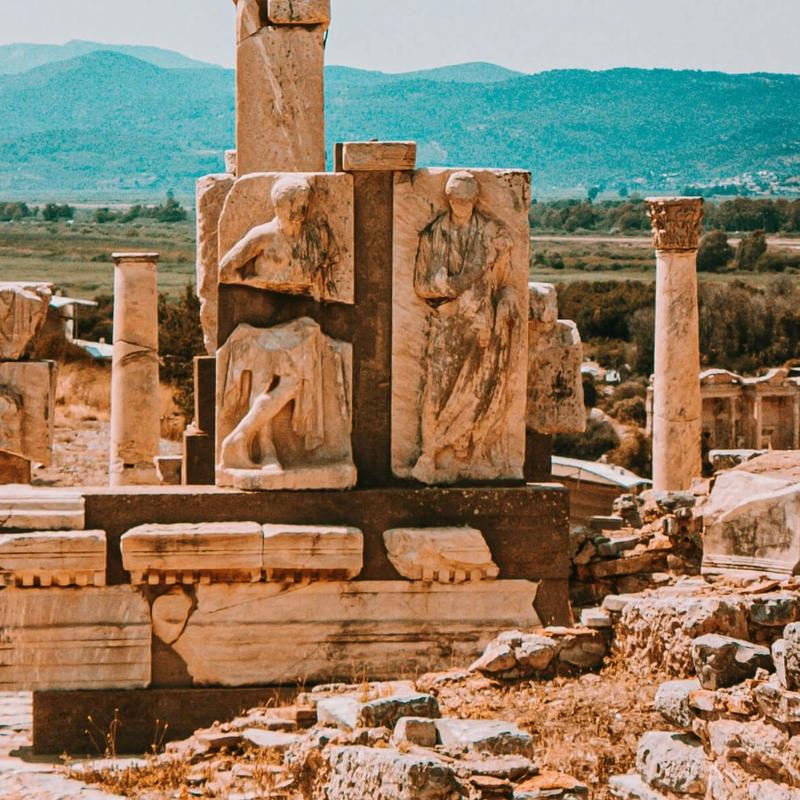
In the ancient world, everyone believed in magic and spiritual powers. So, if you were taking your family to Ephesus, you’d likely prepare for the trip by burning incense to the mother goddess. And the night before your vacation, you might take out the old magic book that your grandfather gave you and chant a spell to ensure a safe trip.
The ancient world, the world of Ephesus, was a world of religious superstition—of magic, goblins, and fairies. In some ways, it was like our world today, where Wicca, astrology, and other occult practices keep getting more popular.
It was also like our world today in another way: ancient religion tended to be pluralistic. If you worshipped Artemis, you likely worshipped a bunch of other gods and goddesses, too.
Religion in Ephesus, as in much of the ancient world, was like a cafeteria lunch line. As you go through the line, you pick a bit of this and a bit of that. You get a bit of magic, add some emperor worship, grab some adoration of Artemis, and so on until you’ve filled up your tray.
People are like that today. They might say, “I want a bit of Jesus, but I also like Buddha. Hinduism has some cool ideas, too. Lately, though, I’m really getting into Jewish mysticism. I don’t go to church because I hike on Sundays to connect with nature. Oh, and I just found this great moisturizer that drives negative energy out of my body.”
Inventing your own religion by picking bits and pieces of teachings you find feels normal in our culture. Many feel most comfortable saying, “I’m spiritual but not religious.”
In other words, like the ancient Romans, we’re comfortable with a lot of gods. Most people today are religious pluralists, just like most people in Ephesus. And as religious pluralists, we tend to be pragmatic. We stick with whichever god works for us.
The apostle Paul met people like that in Ephesus, those who thought the name of Jesus seemed like a great new source of magical powers.
The New Power
In Ephesus, Paul performed miracles through the power of the Holy Spirit. He healed the sick and drove evil spirits out of people (Acts 19:11–12). Some traveling exorcists, sons of a Jewish high priest, saw Paul’s power and tried to tap into it. These men cast demons out of people for a fee—exorcism was their business. They thought casting out demons in the name of Jesus would be a great way to increase profits.
It didn’t go well for them, though. When they “undertook to invoke the name of Lord Jesus over those who had evil spirits,” (Acts 19:13) it didn’t work. Instead, “the man in whom was the evil spirit leaped on them, mastered all of them and overpowered them, so that they fled out of that house naked and wounded” (Acts 19:16).
Jesus wasn’t some new magical power they could harness. Paul came in the name of one utterly different than the gods of Ephesus. And the disastrous experience of these exorcists made this difference obvious to everyone: “And this became known to all the residents of Ephesus, both Jews and Greeks. And fear fell upon them all, and the name of the Lord Jesus was extolled. Also, many of those who were now believers came, confessing and divulging their practices. And a number of those who had practiced magic arts brought their books together and burned them in the sight of all” (Acts 19:17–19).
The people of Ephesus had encountered a new form of religion. This religion didn’t just boast about power, like the magic books of the day. Jesus was a name that actually had power. It could change lives. A number of magicians burned their magic books and came to Jesus, a power they couldn’t manipulate. This power came not mainly through healings and exorcisms but instead through Paul’s gospel, which was the word of God to the world. That’s what gained the victory: “So the word of the Lord continued to increase and prevail mightily” (Acts 19:20).
These magicians saw real power, the power of salvation, and thought, “We don’t need these books anymore.”
Do You Want A Little Bit of Jesus?
Are you a person who just wants to add a little bit of Jesus to your life? Is Jesus just one of the many gods you worship? Maybe you worship Jesus on Sundays, but Monday through Saturday, you’re burning incense to your job, your bank account, your kitchen remodel, your kids’ travel team, or your golf game.
Do you only come to Jesus when you think he’ll be useful to you?
The more God’s word takes root in our hearts, the less this will be true of you. But without trust in God’s word, Jesus will always just be one god among many in your life.
Jesus Christ is honored only when he alone is worshiped and our other gods are cast aside. That’s why the Ephesian magicians burned their magic books that invoked the gods. When they heard the truth of the gospel and saw the power of the Holy Spirit at work in Paul, they looked at their old magic books and thought, “Junk. Lies.” The things that they had relied on for success, meaning, and power turned to ash.
That’s also what we do when we grasp the power of Jesus Christ. We throw everything else we once worshiped into the fire.
____________________________________
This is an excerpt from Sola Media’s Bible Study on Ephesians, by Adriel Sanchez and Josh Maloney. The entire study is available here.