

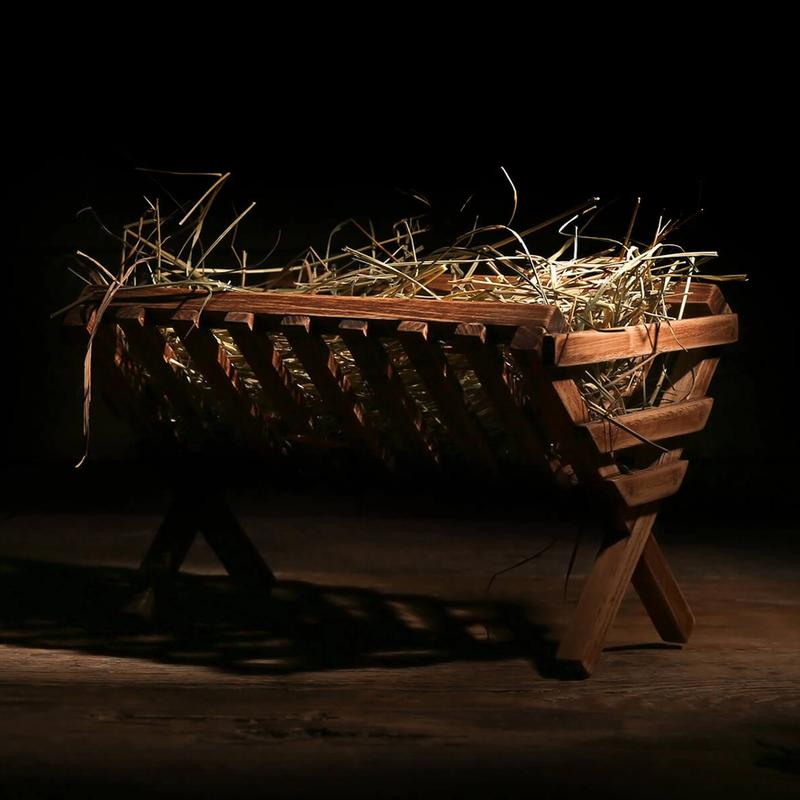
The Christian faith is full of so many astonishing turns of events, unexpected twists, and unfathomable paradoxes that the ancient Latin theologian Tertullian of Carthage felt compelled to exclaim, "Credo quia absurdum!" ("I believe because it is absurd!"). While we certainly affirm the rationality and clarity of our faith, sometimes we have no choice but to join Tertullian in a chorus of dumbfounded praise. We worship the God who created the universe from nothing, who opened the womb of an old barren woman, who delivered a band of slaves from the world's mightiest despot, who set up a shepherd boy as king, and who used a persecutor of the faith to take the message of salvation to the ends of the earth.
But most of all—and especially during this Advent season—we ponder the great mystery that the Creator of the universe willingly assumed our human form and dwelt among us as Immanuel, allowing himself to be born in a stable to otherwise insignificant parents. In the eyes of the world, all this is absurd. But what is foolish to the world is wise to God (1 Cor. 1:27).
For centuries, God's people had enjoyed his covenantal presence through various forms—whether by powerful manifestations such as the cloud by day and fire by night or by lasting institutions such as the temple in Jerusalem. But all these were mere shadows pointing to a greater fulfillment: God himself dwelling with his people as man. Some 2,000 years ago, the divine person of the Son assumed a complete and sinless human nature, living, walking, talking, laughing, and weeping with his creation and his people.
Looking back at the Old Covenant from our New Covenant perspective—and with Spirit-illumined minds—it seems obvious that God's plan all along was to send his Son through a virgin in Bethlehem to die and rise again for the redemption of his people. It can even be frustrating to read of the disciples' inability to recognize Jesus for who he is! But apart from divine inspiration in prophecy and divine illumination in study, God's people could have scarcely imagined or predicted what was to come. The very idea that God had come as man was so apparently absurd that most of the Jewish leaders took it as blasphemous. In truth, no one was able to recognize and appreciate the mystery of the Incarnation unless the Spirit opened their eyes to make them see (Matt. 16:17).
Consider Simeon, who had presumably lived quite long with the promise that he would not die before seeing the Messiah in the flesh. When his eyes at last rested on the promised Messiah, he at once began to worship, "Sovereign Lord, as you have promised, you may now dismiss your servant in peace. For my eyes have seen your salvation, which you have prepared in the sight of all nations: a light for revelation to the Gentiles, and the glory of your people Israel” (Luke 2:29–32). We read prior to his doxology that it was the Spirit who had befallen him and stirred within him to enter the temple courts, where he soon thereafter met the infant Christ. Enlightened by the Spirit, Simeon perceived Christ as the fulfillment of God's ancient promises, types, and shadows. But while Simeon—unlike the Pharisees—understood the significance of the baby cooing in his arms, it was only because the Spirit had moved within him and illumined his mind to the truth. Apart from the Spirit, Simeon would have found the birth of God an impossible and perhaps even blasphemous notion—simply too absurd!
The outworking of God's redemptive plan is unpredictable and perplexing to us finite and sinful creatures. It is, in the words of Paul the Apostle, foolish to those without the Spirit. But we must not leave the Christmas story at its apparent absurdity. It is indeed astonishing that the divine Son would become man—let alone subject himself to a humble birth, a low social status, and the pangs of suffering and death. But 'absurdity' is not the only wise God's ultimate aim or intention. God did not arrange the virgin birth of his divine Son as a spectacle to bewilder mankind that he might win some applause for being clever. No, at the heart of this confounding mystery of the Nativity is God's love for us.
The Nativity owes its baffling mystery to the incomprehensibility of God's infinite greatness and his infinite love (Eph. 3:18). That God, who transcends all human thought, would come down and join himself to rebellious sinners and a cursed creation only makes sense when we ponder his overwhelming love. The incarnation and birth of the divine Son, appearing at first an absurd paradox, is resolved by God's desire to be with his people. And yet, it is this same divine love that conceives and births the paradox itself! For it is unthinkable that the almighty God would be born as a helpless baby because it is equally inconceivable that the righteous God would offer up his own Son to redeem wicked sinners. We will never be able to completely understand the Nativity's mystery unless we first do the same with God's love, which lies far beyond our grasp as small creatures.
Therefore, the Nativity never quite loses its brilliance and splendor. It is a delightful thing to know that we will have all eternity to joyously grapple with the incomprehensibility of God's love, which both creates and resolves the paradox of the Nativity.
Since the infinitude of God's love is what begins to make sense of the incarnation and birth of the divine Son, then for those who do not know God's love, the Nativity remains forever an absurdity—and nothing more. For only God's powerful and gracious work in the human heart can make sense of the confounding wisdom of his redemptive plan and eternally unravel the great mystery of the God-Man.
If in the eyes of the world, the Nativity is absurd, credimus quia absurdum!
Footnotes
The more complete rendering of Tertullian of Carthage's famous exclamation goes, "The Son of God was crucified; I am not ashamed because men must needs be ashamed of it. And the Son of God died; it is by all means to be believed because it is absurd. And he was buried and rose again; the fact is certain because it is impossible" (Tertullian of Carthage, "On the Flesh of Christ," Latin Christianity: Its Founder, Tertullian, ed. Alexander Roberts, James Donaldson, and A. Cleveland Coxe, trans. Peter Holmes, vol. 3, The Ante-Nicene Fathers (Buffalo, NY: Christian Literature Company, 1885), 525. Tertullian was of course not advocating that God's plan and work are foolish, but rather that they appear so in the eyes of an unbelieving world.
The prophetic texts are as follows: A divine Savior (Isa. 9:6); born of a virgin (Isa. 7:14); in Bethlehem (Mic. 5:2); who would die a substitutionary death (Isa. 53:5–8); and rise again from the dead (Ps. 16:9–10). There are, of course, many other passages that we could reference for these particular elements of our Lord's person and work.