

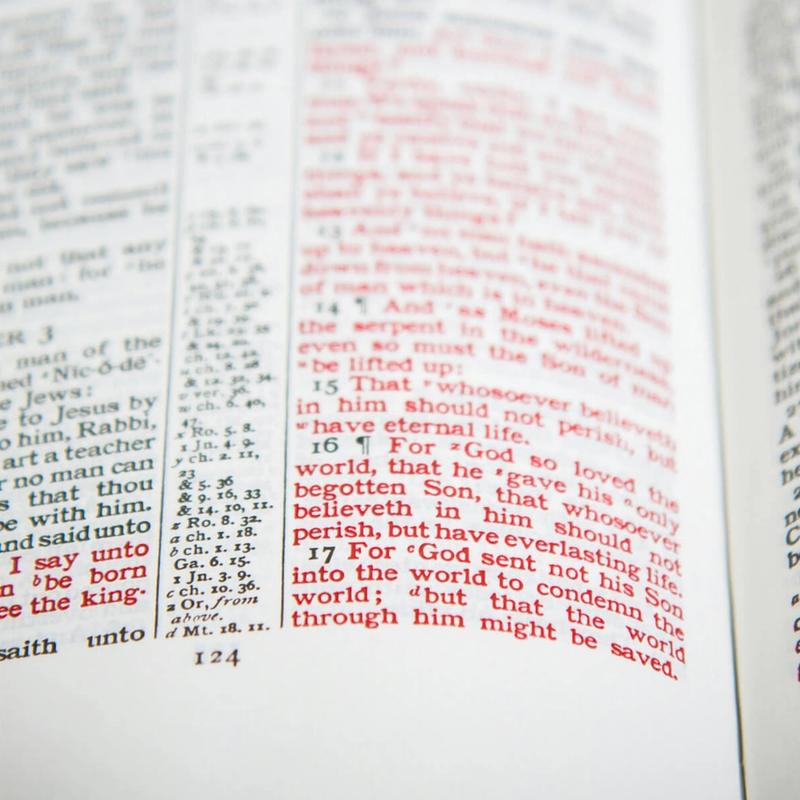
Toward the end of his life, Thomas Jefferson—an accomplished statesman and former president—took on a private project: reassembling the Bible. Cutting texts primarily from the teachings of Jesus, he compiled an 84-page work that excluded the resurrection and ascension of Christ, as well as all of his miracles. The Jefferson Bible is perhaps the prototype of what some call “Red Letter Christianity,” where only the words of Jesus are considered Scripturally binding.
The concept of Red Letter Christianity is an interesting one that gets at the core of what we believe about God’s word, its purpose, and its authority. How much of Scripture is useful for the Christian life? Are the words of Jesus more important than the rest? Can we use outside sources to inform our understanding of the Bible?
Often, these questions are addressed by two different schools of thought: Biblicism and Sola Scriptura. Biblicism is the belief that the Bible is a sufficient authority for any question that might arise in the Christian life, that only the Bible should be consulted, and only what we find in the Bible.
Sola Scriptura, by contrast, is the Reformational principle that Scripture is the only infallible source of authority regarding salvation. Sola Scriptura became a way to push back against the Roman Catholic Church’s “Traditions” of interpreting Scripture and ascribing “infallibility” to the Pope’s decrees on matters of faith and practice. Only Scripture is needed for our faith.
Perhaps that difference between Biblicism and the doctrine of sola Scriptura may seem negligible, but the significance of its application is critical. It’s the difference between cutting out the words of Christ in order to guide your life’s decisions and falling upon the whole counsel of God for the salvation of your eternal soul.
What Is the Purpose of Scripture?
Scripture is God’s inspired word, and though translations and copiers may make mistakes, the original revelation given to Moses, the prophets, the apostles, and various writers of the books within the Bible is infallible—it cannot make mistakes (cf 2 Pet. 1:21). If the Bible is indeed the very words of God, they must all be valuable and have purpose. Scripture affirms this about itself as well: “All Scripture is breathed out by God and profitable for teaching, for reproof, for correction, and for training in righteousness, that the man of God may be complete, equipped for every good work” (2 Tim. 3:16–17). So, all Scripture is profitable for spiritual instruction, and its purpose is to equip us for “every good work.” But the context of these verses from Paul to Timothy is important. Paul refers to these “sacred writings, which are able to make you wise for salvation through faith in Christ Jesus” (2 Tim. 3:15).
The primary purpose of Scripture is to make us wise for salvation. The Bible is the story of man’s fall and Christ’s redemption. It’s the story of the church throughout the ages, from primeval garden to eternal paradise, as carried along by the promises of God.
Yes, there is plenty of wisdom to find about relationships, parenting, and personal decisions, but the Bible isn’t about those things. The Bible is the book of our salvation. That is its primary purpose.
How Should We Understand What Scripture Says?
But, even though what we need to do in order to be saved is perfectly clear from God’s word (“if you confess with your mouth that Jesus is Lord and believe in your heart that God raised him from the dead, you will be saved,” Romans 10:9), the Bible can be difficult to read. How are we meant to understand Levitical laws? Or how can we affirm doctrines we don’t find specifically in the text of Scripture?
The Roman Catholic Church holds that the Bible needs an infallible interpreter—the Pope—to help us understand what might not seem clear. In response, the Reformation helped to bring back a proper study of God’s word, which includes looking at Scripture in light of its original context—the language and genre of writing—and with the help of the creeds and confessions of the early church. Sola Scriptura doesn’t mean we only look at Scripture, but that Scripture is the only infallible revelation from God that we need. We can hold to sola Scriptura while still leaning on other tools to aid our understanding of God’s word and promises.
One example of this is the doctrine of the Trinity. The Trinity was hotly debated for the first few centuries of the early church. Is God one or three? Does Jesus have both human and divine natures? Are the persons of the Trinity equal, and what is their relationship?
To answer these questions, Christians studied Scripture diligently, and their spirit-led wisdom has been codified in our creeds and confessions as an aid to other Christians so that we might not stumble back into heresy.
Biblicism, in contrast, would say that the Bible is equally clear in all things, not just in matters of salvation. Biblicism would have us ignore these creeds and read the Bible as though we are seeing it for the first time. It reads the Bible in isolation from the rest of Scripture and in isolation of the history of interpretation of the church. As the word “Trinity” does not appear anywhere in the Bible, some Biblicists would even discard the doctrine of the Trinity entirely.
Sola Scriptura incorporates the belief that Scripture interprets Scripture—we can only understand it as a whole.
All of Scripture for all of Life?
What then are the limits of using Scripture to guide our lives? There are many pressing issues Western Christians face today that the Bible doesn’t name directly: transgenderism, undocumented immigration, Christian Nationalism. What about questions of trade and economics?
In a class on homeownership, I once heard someone say he didn’t think it was right for him to charge clients interest because of Old Testament laws: “If you lend money to any of my people with you who is poor, you shall not be like a moneylender to him, and you shall not exact interest from him” (Exod. 22:25, cf Deut. 23:19).
The Reformational approach to Scripture would point us to the nature of the laws given to the nation of Israel. Her civil laws, like this one, expired with the nation itself. God’s people today are not bound by them.
What we can see is that Christ has come and made us citizens of a better country, in which we have a great inheritance. And because of that eternal wealth, we do not need to cling to what we have in this life.
Do not lay up for yourselves treasures on earth, where moth and rust destroy and where thieves break in and steal, but lay up for yourselves treasures in heaven, where neither moth nor rust destroys and where thieves do not break in and steal. For where your treasure is, there your heart will be also.— Matthew 6:19–21
With this view of what we have through our union with Christ, individual Christians have the liberty to decide whether or not to charge reasonable and lawful interest. The order and justice of God’s world allow us to do so. The riches stored up for us in eternity, and our trust in the Lord’s provision for what we need in this life, give us the freedom not to.
Only with a proper understanding of what Scripture means to tell us—about our salvation and union with Christ—can we arrive at that place of nuance.
The Jefferson Bible is a prime example of Biblicism—isolating Scripture from itself. By cutting away all but the red letters, Jefferson missed out on a lot. We need the whole of Scripture to give us context to Christ’s teachings, our need for his obedience, the truth of his resurrection, and the new people we become in Him.
Footnotes
“Why Thomas Jefferson Rewrote the Bible without Jesus’ Miracles and Resurrection.” History.com, May 28, 2025. https://www.history.com/articles/thomas-jefferson-bible-religious-beliefs.